AI vs. AI: What ARTEX Teaches Us About Fighting Machine-Speed Attacks
Three Hours to Privileged Access: Why Your SOC Needs AI Before ARTEX Finds You
On November 13, 2026, the FBI released FLASH-20261113-001, a TLP:CLEAR alert describing ARTEX, an open-source, AI-driven penetration testing framework that criminal and state-linked actors have turned into an intrusion engine. The headline number is the one every security leader should sit with: in some intrusions, attackers went from initial targeting to privileged access in under three hours. That is not a typo, and it is not a lab demo. It is the new baseline for how fast an attacker can move when an AI agent does the work.
For years, the conversation about AI in security has been speculative. Will attackers use AI? How much will it help them? ARTEX ends that conversation. Attackers are using autonomous AI agents now, at scale, against financial services, government, healthcare, defense, energy, manufacturing, and technology organizations. The question is no longer whether you will face an AI-driven attack. The question is whether your defenses can operate at the same speed.
This brief covers what ARTEX is, what the FBI actually reported, why speed rather than stealth is the real threat, and how organizations can use AI on both sides of the fight: in the SOC to detect and respond faster, and in authorized red-team programs to find weaknesses before an attacker's agent does.
What ARTEX Is
ARTEX is a multi-agent offensive security framework written in Go with an embedded Next.js web console. A developer using the handle Autumn-27 published it on GitHub in July 2026, pitching it as a tool for learning, research, and testing authorized assets. It attracted a large following quickly.
The architecture is simple and effective. An operator gives ARTEX a target and an objective. A planner agent breaks that objective into tasks. Worker agents execute those tasks using standard security tools, and the framework records discovered assets, findings, and progress in a shared graph that every agent can read. Think of it as a project manager directing a team of junior penetration testers who never sleep, never get bored, and never forget what a teammate found an hour ago.
The most important design detail is what ARTEX does not include: its own AI model. It plugs into external large language model providers, including frontier models such as Anthropic Claude and OpenAI GPT, as well as open-source and Chinese-origin models such as DeepSeek, GLM, and Kimi. The FBI reported that Chinese models are the most common in attacker-controlled deployments, with the DeepSeek Flash family appearing most frequently. Low cost and weaker guardrails against requests framed as penetration testing are the likely draw.
The original repository was taken down by its creator on October 8, 2026 after reports of abuse, and the author has said they were not involved in the attacks. That takedown did not stop anything. The framework continues to spread through community forks, archived copies, localized variants, and a commercial edition called ARTEX PRO. Researchers cited in the FLASH counted more than 1,600 ARTEX consoles exposed on the public internet.
What the FBI Actually Reported
Security leaders will get asked about ARTEX by boards, executives, and customers, so it is worth being precise about what the FBI said rather than repeating amplified secondhand coverage.
The FBI reported that a variety of malicious cyber actors have used ARTEX against organizations globally since at least August 2026. Two campaigns stand out. The first was a financially motivated attack against South Korean financial institutions that exfiltrated personal information on approximately 67,000 individuals (some outlets report 68,000; the FBI figure is the one to cite). The second was a supply chain campaign abusing ConnectWise Cloud Backup application identities, in which attackers attempted authentication against more than 2,250 downstream Microsoft 365 tenants; Huntress reported at least 162 tenants compromised. Separate reporting by BleepingComputer tied a Chinese espionage group tracked as Vapor Panda to ARTEX-assisted targeting of more than 200 organizations across 14 countries, with at least nine confirmed compromises.
The FBI assessed four core risks. ARTEX automates the slow enumeration and exploitation phases of an intrusion, so small groups can run many campaigns at once. It lowers the skill barrier, so actors with minimal expertise can execute sophisticated attack chains. It is especially effective against overlooked systems. And it has demonstrated supply chain capability, mapping trust relationships between organizations to pivot from weaker vendors into high-value networks.
The FBI's recommended mitigations are, notably, conventional: secure internet-facing applications, restrict access to cloud administration interfaces, review application permissions and authentication logs, apply rate limiting, and above all, inventory and shrink the external attack surface. There is no magic anti-ARTEX product. The fundamentals still work. What changed is how little time you have to apply them.
Speed, Not Stealth, Is the Real Threat
Here is the detail most coverage buries: ARTEX is noisy. The FBI noted that its traffic may well trigger alerts. This is not a stealthy, living-off-the-land intrusion that evades detection for months. It is loud, fast, and relentless.
That inverts a core assumption in most security programs. We have spent a decade investing in detection, on the theory that the hard part is noticing the attacker. With ARTEX, many organizations will notice. The alert will fire. And then it will sit in a queue behind 400 other alerts while a tier-one analyst works through them in order, escalates at the end of a shift, and waits for an approval to disable an account. By the time a human makes a containment decision, the agent has already enumerated the environment, harvested credentials, and moved on.
A useful analogy for executives: imagine a burglar who sets off every motion sensor in the house but moves through the entire home in ninety seconds. Your alarm works perfectly. The monitoring company calls you in four minutes. The burglar was gone in two. Your problem is not the sensors. Your problem is the gap between the alarm and the response.
For a technical audience, frame it as mean time to respond versus attacker dwell time to objective. Traditional programs measure MTTR in hours or days and consider that acceptable because historical dwell times were measured in weeks. When dwell time to privileged access compresses to under three hours, any response process with a human approval bottleneck at every step will lose. The metric that matters now is time from high-confidence detection to containment action, and it needs to be measured in minutes.
This is the core of the AI vs. AI argument. You cannot hire your way to minute-level response across thousands of daily alerts. You can automate your way there, provided you automate carefully.
The Attack Surface ARTEX Loves
The FBI specifically called out the systems ARTEX is best at finding: partner and supplier portals, mobile backends, employee and sales-support tools, legacy services, and third-party integrations. These are the systems that rarely get the same security attention as the flagship customer application.
Every organization has them. The sales team's quoting tool that a contractor built three years ago. The vendor portal that still accepts password-only logins. The mobile API that was secured at launch and never re-tested. The integration service account with far more permissions than it needs. Humans skip these systems during assessments because they look unimportant and time is limited. An AI agent does not get bored and does not prioritize by prestige. It enumerates everything, and the forgotten system is often the open door.
The supply chain angle matters just as much. ARTEX maps trust relationships. If your organization is well defended but your managed service provider, backup vendor, or software supplier is not, the agent will go through them. The ConnectWise Cloud Backup campaign shows the leverage: one abused vendor integration, more than 2,250 downstream tenants targeted. Your third-party risk program now needs to ask vendors a direct question: how quickly can you detect and contain an automated intrusion, and how would you notify us?
The Uncomfortable Detail: It Runs on the Same LLMs You Use
Most organizations reading this are not building their own AI models. They consume LLMs through APIs from providers like Anthropic, OpenAI, and Google, and through integration platforms. ARTEX is built exactly the same way. The attacker is an API consumer too.
This has three practical implications. First, model choice shapes risk on both sides. Attackers gravitating toward low-cost models with weaker guardrails suggests that provider-side safety controls are a real friction point for attackers, which is a reason to factor safety posture into your own provider selection and vendor risk reviews. Second, your own LLM API keys are now attack infrastructure if they leak. A stolen key with a generous spending limit can fund someone else's agent campaign on your bill, so secrets management, spend caps, and usage anomaly alerts on AI provider accounts are no longer optional. Third, the components that make ARTEX dangerous, an orchestrator, a planner, tool-using agents, and shared memory, are the same components in the agents your own teams are deploying for legitimate work. If you would not let an agent with that architecture run without scope limits and approval gates, you should not let your internal agents run that way either.
Defense: Putting AI in the SOC
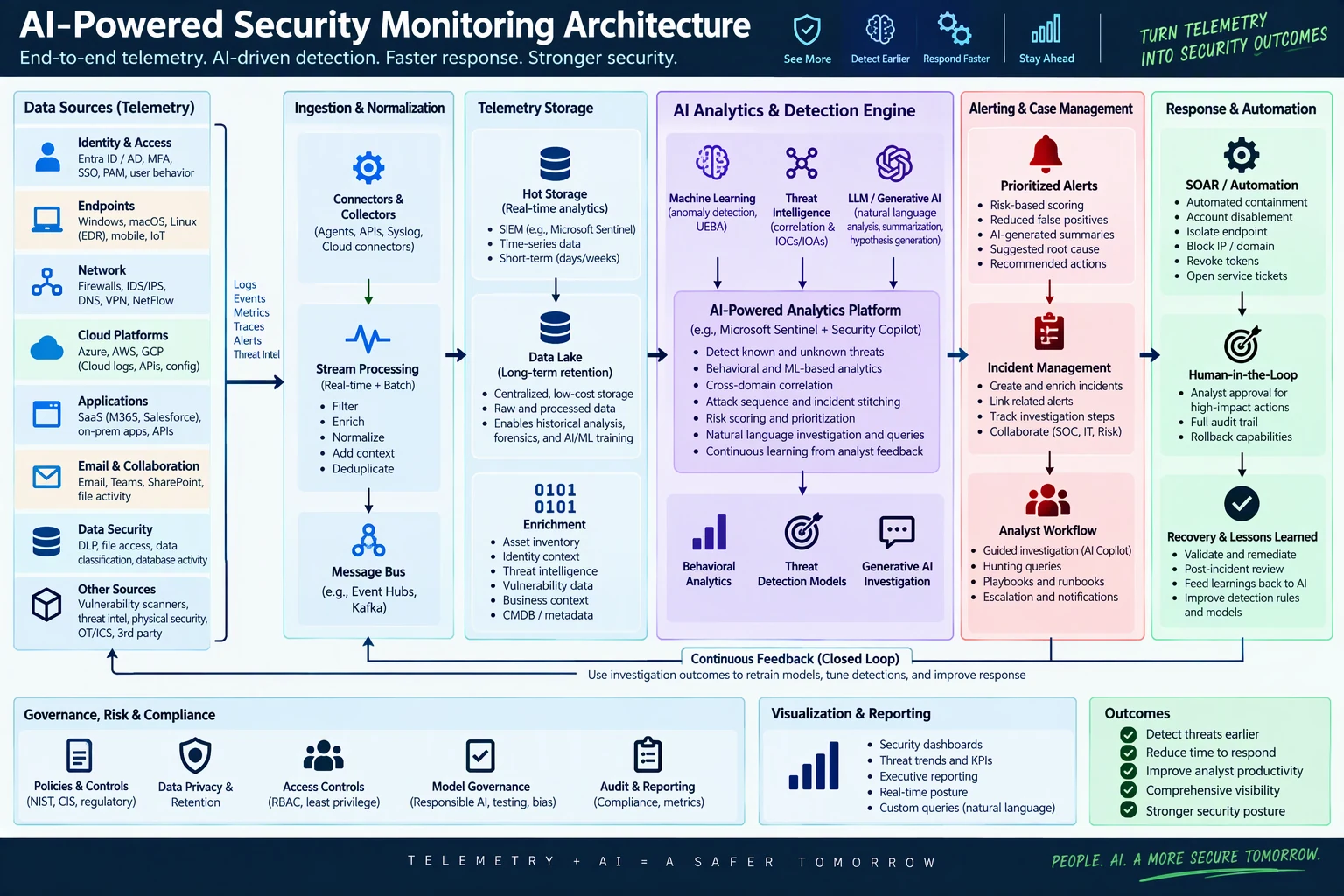
Figure: AI-Powered Security Monitoring Architecture
The diagram above shows a reference architecture for AI-assisted security monitoring. It is worth walking through layer by layer, because the value of AI in the SOC depends entirely on the layers underneath it.
Telemetry is the foundation. Identity and access logs, endpoint detection, network flows, cloud platform logs, SaaS application activity, email and collaboration activity, and data security signals all feed in. Given what ARTEX targets, pay particular attention to coverage of the overlooked systems: partner portals, mobile backends, legacy services, and service accounts. An AI analytics engine cannot detect activity on a system that sends it no logs.
Ingestion and normalization make the data usable. Connectors and collectors pull data in, stream processing filters, enriches, normalizes, and deduplicates it, and a message bus moves it reliably. This unglamorous layer determines whether your AI sees one coherent attack or five hundred unrelated events.
Storage splits by purpose. Hot storage in a SIEM supports real-time analytics. A data lake holds long-term, lower-cost data for forensics, historical hunting, and training detection models. Enrichment adds asset inventory, identity context, threat intelligence, vulnerability data, and business context, which is how the system knows that an anomalous login matters more on the finance administrator's account than on a test account.
The AI analytics and detection engine is where machine speed begins. Machine learning handles anomaly detection and user and entity behavior analytics. Threat intelligence correlates indicators of compromise and attack. Generative AI handles natural language investigation, summarization, and hypothesis generation. The most important capability against ARTEX is attack sequence stitching: correlating reconnaissance, credential access, and lateral movement across domains into a single incident. ARTEX is noisy, so the signals exist. The value is assembling them into one high-confidence story fast enough to act.
Alerting and case management convert detection into decisions. Risk-based scoring reduces false positives, AI-generated summaries explain what happened and suggest root cause, and incidents are created and enriched automatically. An analyst who opens a case with a plain-language summary, linked alerts, and recommended actions decides in minutes instead of an hour.
Response and automation close the speed gap. This is the layer that actually beats a three-hour attack. SOAR playbooks can automatically disable accounts, isolate endpoints, block IPs and domains, and revoke tokens. The key design decision is which actions are pre-authorized and which require a human. The architecture keeps a human in the loop for high-impact actions, with a full audit trail and rollback capability.
Deciding What to Automate
The practical question every security leader faces is where to draw the automation line. A workable rule: automate actions that are high-confidence, reversible, and narrow in blast radius, and require human approval for actions that are broad, disruptive, or hard to undo. Revoking a session token for an account showing impossible travel plus a new MFA device registration is reversible and narrow, so automate it. Isolating a single workstation exhibiting credential dumping behavior is reversible, so automate it. Disabling a production service account that runs payroll is disruptive, so route it to a human, but with a pre-staged decision and a target approval time measured in minutes, not hours.
The work that makes this possible happens before the incident. Pre-approve containment playbooks with business owners now, in daylight, so that during an incident nobody has to find the VP of Sales at 2 a.m. to ask whether the CRM integration account can be disabled. Pre-authorization is a governance decision, not a technical one, and it is the single highest-leverage step most organizations can take against machine-speed attacks.
The closed loop makes the system improve. Investigation outcomes feed back to retrain models, tune detections, and refine playbooks. Every ARTEX-style intrusion attempt you contain becomes training data for detecting the next one faster.
Governance wraps around all of it. Policies and controls mapped to frameworks such as NIST and CIS, data privacy and retention, role-based access with least privilege, model governance covering testing and bias, and audit reporting. Defensive AI is still AI, and it needs the same governance you would apply to any AI system making consequential decisions.
Offense: Attack Yourself First, Safely
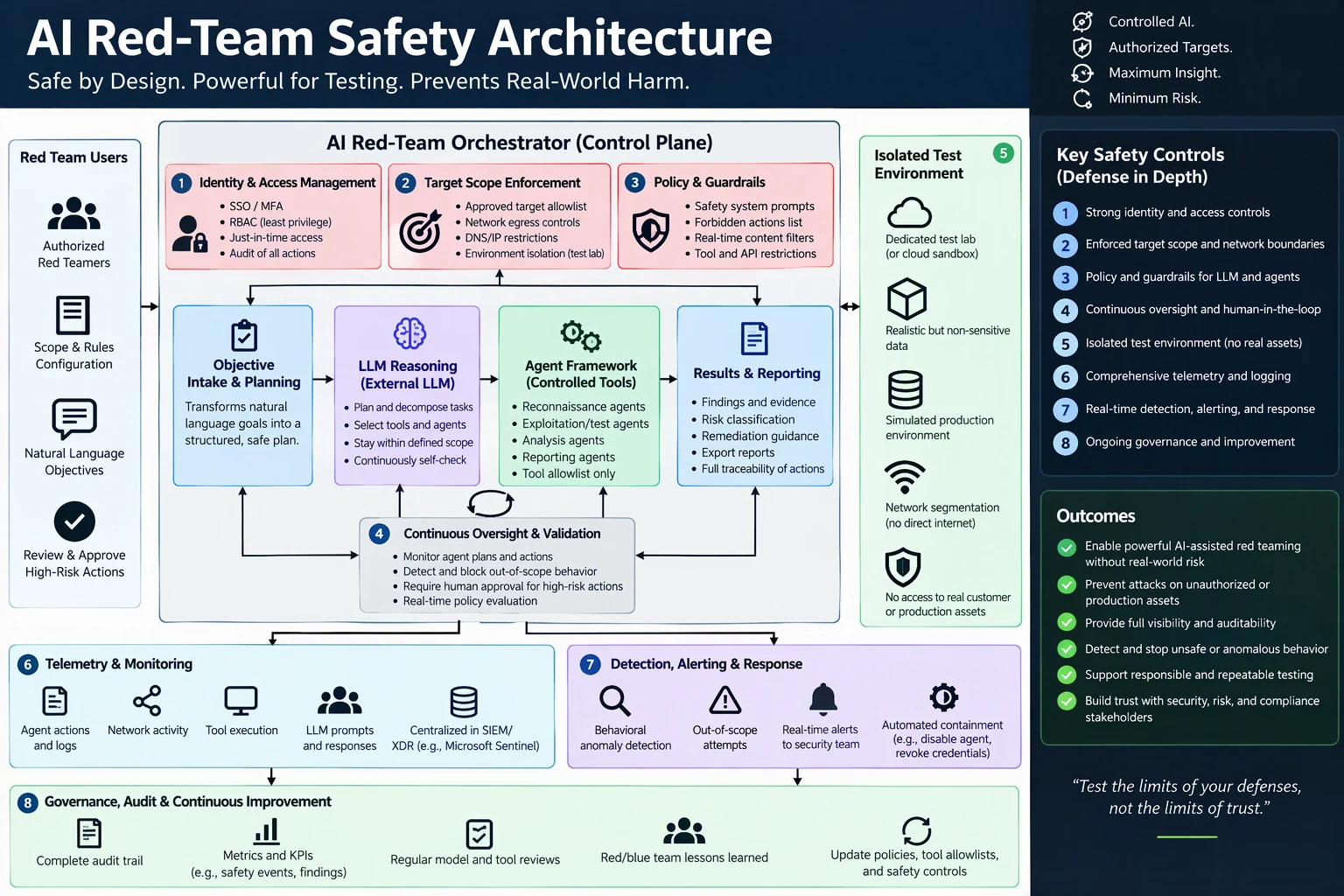
Figure: AI Red-Team Safety Architecture
The second half of the AI vs. AI strategy is uncomfortable for some organizations: use AI agents to attack yourself before someone else does. If an attacker's agent will enumerate every forgotten portal and over-permissioned service account in hours, you want your own authorized agent to find them first. Annual, human-only penetration tests scoped to the flagship application will not keep pace with an adversary that tests everything continuously.
The diagram above shows what responsible AI-assisted red teaming looks like. Read it alongside ARTEX, because nearly every control in it is something ARTEX's attackers deliberately avoid.
Identity and access management limits use to authorized red teamers with SSO, MFA, least-privilege roles, just-in-time access, and an audit trail of every action. Target scope enforcement is the most important control: an approved target allowlist, network egress restrictions, and DNS and IP controls that physically prevent the agent from touching anything outside scope. Policy and guardrails constrain the LLM and its tools with safety system prompts, a forbidden actions list, content filters, and tool and API restrictions.
The orchestrator then moves from objective intake and planning, through LLM reasoning that decomposes tasks and continuously self-checks against scope, to an agent framework that runs only allowlisted tools, and finally to results and reporting with full traceability. Underneath it all, continuous oversight monitors agent plans and actions, blocks out-of-scope behavior, and requires human approval for high-risk actions.
Testing runs in an isolated environment with realistic but non-sensitive data, a simulated production environment, network segmentation without direct internet access, and no access to real customer or production assets. Telemetry and monitoring capture agent actions, network activity, tool execution, and every LLM prompt and response in the SIEM, and detection and response watch the red-team agent itself for anomalous or out-of-scope behavior, with automated containment that can disable the agent and revoke its credentials.
One practical note: isolated test environments are ideal for validating detection and response, but finding forgotten external systems requires carefully scoped testing against your real external attack surface. That is where the target allowlist, rate limits, written authorization, and human approval gates earn their keep. Engage a qualified provider if you do not have the in-house capability, and require them to show you these controls before any agent touches your environment.
There is a bonus that makes this worth the investment. Running an authorized AI red-team agent against your environment is the best possible test of the AI-assisted SOC described above. If your monitoring cannot detect and contain your own agent, it will not detect and contain an attacker's.
The Control Gap That Turned a Pentest Tool Into a Weapon
ARTEX is a cautionary tale about dual-use AI. Its original purpose, helping organizations test their own defenses, was legitimate. What made it dangerous was not the planner agent or the tool integrations. Those same components appear in responsible red-team platforms. What was missing were the controls on who can use it, which targets it can touch, and who approves high-risk actions. Once forked and stripped of whatever guardrails the community expected, it became an intrusion engine.
The lesson applies beyond offensive tools. Every organization deploying agentic AI, for customer service, IT operations, finance automation, or software development, is deploying the same architectural pattern. Scope enforcement, least-privilege tool access, human approval for high-impact actions, and complete logging are not red-team niceties. They are the baseline for any agent that can take actions in your environment.
A 30-Day Action Plan
Week one: inventory and shrink. Build or refresh your external attack surface inventory with specific attention to partner portals, mobile backends, sales and employee tools, legacy services, and third-party integrations. Decommission what you can. Enforce phishing-resistant MFA on what remains. Restrict cloud administration interfaces to managed devices and known networks.
Week two: close the credential gaps. Rotate exposed or long-lived cloud credentials, audit service account permissions, and remove standing privileged access in favor of just-in-time elevation. Put spend caps and anomaly alerts on your own AI provider accounts and rotate any LLM API keys stored in code or shared documents.
Week three: pre-authorize response. Work with business owners to approve automated containment for high-confidence, reversible actions such as token revocation, session termination, and endpoint isolation. Define the human approval path and target approval time for disruptive actions. Measure your current time from high-confidence detection to containment and set a target in minutes.
Week four: test and extend. Run a scoped tabletop exercise built around a three-hour intrusion timeline and see where your process breaks. Ask your critical vendors and managed service providers how they detect and contain automated intrusions. Scope an authorized AI-assisted red-team engagement with the safety controls described above.
The Bottom Line
ARTEX is not the last AI attack framework. It is the first one to make headlines, and the forks are already multiplying. The organizations that come through this era intact will not be the ones with the most alerts or the biggest analyst headcount. They will be the ones that close the gap between detection and response to minutes, that know their entire attack surface before an agent maps it for them, and that govern their own AI agents with the controls ARTEX's operators abandoned.
AI vs. AI is not a slogan. It is the operating reality. Attackers have automated the offense. Defenders need to automate the response, keep humans in charge of the decisions that matter, and test themselves continuously. The fundamentals have not changed. The clock has.